Graphic: Cosmopolitan Courier
Australian owners are working longer with little room to spare. The answer, one former café owner argues, isn’t louder marketing but less of it that needs you.
By Eugene Gilbert Walters, Editor in Chief

Ask a small business owner what would happen if demand rose by a fifth tomorrow, and the answer is often a tired laugh.
That was, in effect, the question put to owners in the fifth State of Small Business Report from the Council of Small Business Organisations Australia (COSBOA) and Square, released in October, which drew on a national survey of 608 small business owners. Only 25.8 per cent said they could absorb a 20 per cent rise with their current people and systems. The most common answer, at 27.8 per cent, was that they would manage it by working longer themselves. Around two in five owners reported working more hours.
The report is about capacity, not marketing. But it describes a shape most owners will recognise: a business that runs on one person’s time and attention. Marketing, which never quite feels finished, is often where that shows first. And for owners with no slack, the usual advice, to post more, chase more and be everywhere, is a strange kind of help.
A different question
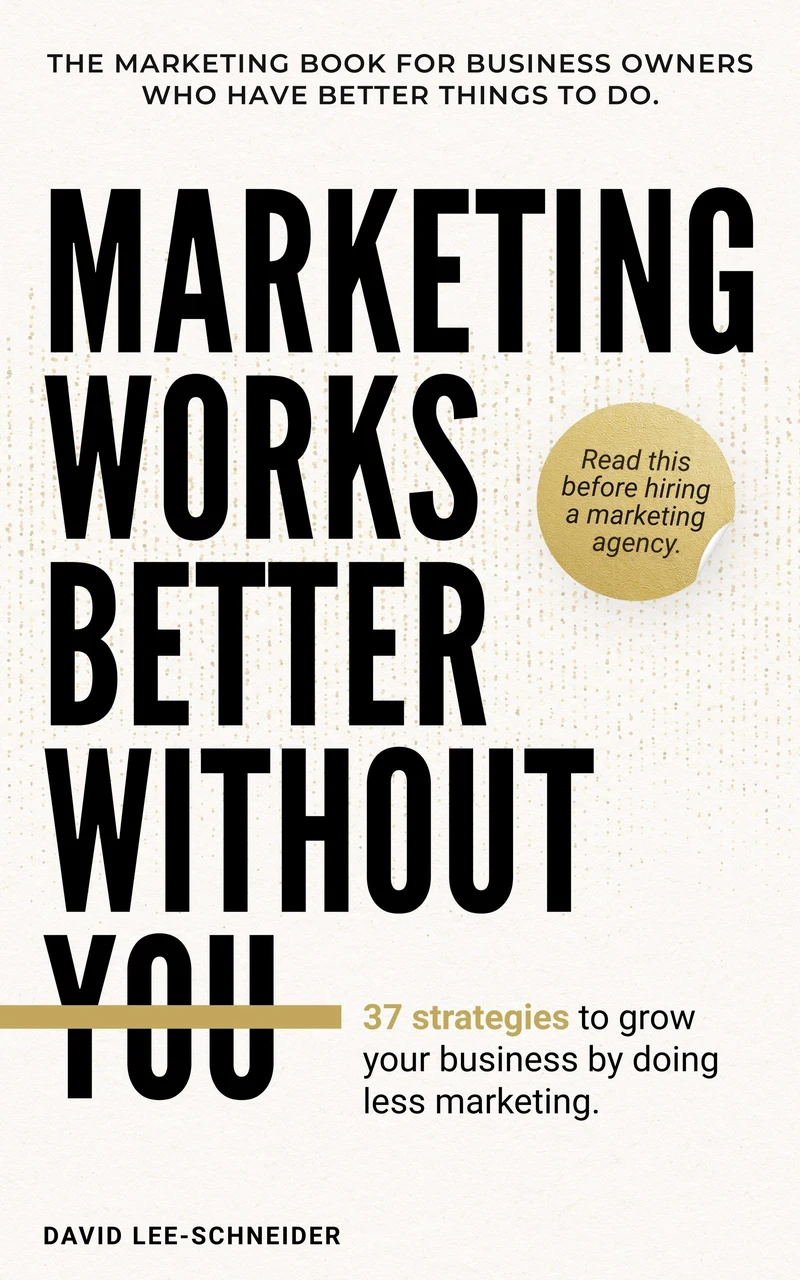
David Lee-Schneider has spent more than 15 years working with business owners. He is a digital marketing consultant, speaker and founder of Done Digital, and his first book, Marketing Works Better Without You, was released in November. His starting point is not a new tactic. It is a different question.
“Every strategy in this book exists to answer one question,” he writes in the introduction. “What can I put in place once, so I don’t have to keep thinking about it?”
His diagnosis is blunt. “Marketing doesn’t fail because you’re not trying hard enough,” he writes. “It fails because too much of it only works while you’re actively pushing it.”
He came to it the hard way. In the author’s note, he describes taking over a small café in Darlinghurst, in Sydney, and finding he “couldn’t see a way to step back without putting everything we’d built at risk”. Four years in, with a second daughter newly born, he was burned out. One Friday night, walking home around eight o’clock, he came through the door and saw “our baby daughter, just a few months old, lying on a little sheepskin rug on the floor”. “You don’t deserve the rest of me. You deserve the best of me,” he thought. “I never said it out loud. But it stayed with me.”
That evening, he writes, “didn’t solve anything. It gave me a reason to find a different way.”
What working without you looks like
The book does not ask owners to do more. Its test for what earns a place is the opposite: “If a strategy requires daily attention, ongoing creativity or constant optimisation to keep working, it isn’t here.” The introduction calls the result “marketing that earns the right to be ignored”.
The clearest illustration is a story in the Foundations chapter. A father on his lunch break is looking for swimming lessons for his four-year-old, who clung to his leg at the edge of the pool at a birthday party. The first school’s booking form asks him to choose a level, and he has no idea which suits a child who will not put her face in the water. He decides to ring after work. Then comes dinner, bath time and an email from a client. He does not ring.
“Nothing went wrong,” Lee-Schneider writes. “Nobody said no.” He calls it the Drift Point: “It’s rarely a no. It’s a yes that never got finished.”
A few days later the father finds a second school, with a page called “Is your child nervous in the water?” It says plenty of children cry in their first lesson, that this is normal, and that parents can stay on the pool deck. “Nothing on that page tried to persuade him,” the book says. “It simply described his daughter.”
The owner of that second school, the book points out, could be in the pool with someone else’s child while the page does its work. Lee-Schneider calls such things Low-Effort Assets: “They take work to put in place, but once they’re working, they keep helping customers find answers, build confidence and take the next step without needing your constant attention.”
The limits
It would be a mistake to read this as a promise of effortless growth, and the book does not make one. It says plainly that effort is not the only reason interest drifts: “Price, timing and fit matter too, and no website can fix a lesson time that clashes with daycare pick-up.” Setting these assets up takes work. A note at the back says no particular result is promised or guaranteed.
The book is also written for a particular reader: owners who “run service-based businesses, who rely on trust, enquiries and real decisions”. Owners of other kinds of business may find less of their own situation here.
And the survey figures above show a squeeze on owners’ time. They do not show that this remedy fixes it. That is a consultant’s argument, drawn from his own experience and clients, rather than independent research, and readers should weigh it as such.
Where to start
What the book offers is a small, specific way in. It does not suggest putting all 37 strategies in place at once. “Choose one strategy,” it says. “Put it in place. Check that it works. Then move to the next one.”
Restraint is not a fashionable word in marketing. For an owner with no slack, it may be the most practical one on offer. In a market full of advice to do more, this is a patient argument for doing less, without pressure and without hype. It’s why, as this magazine’s editor, I call it “A calm antidote to today’s noisy marketing advice.”
Marketing Works Better Without You: 37 strategies to grow your business by doing less marketing by David Lee-Schneider is available in print and as an ebook on Amazon.